What are micro-credentials
Before downloading this worksheet, make sure to read the instructions below
European approach to Micro-credentials for lifelong learning and employability
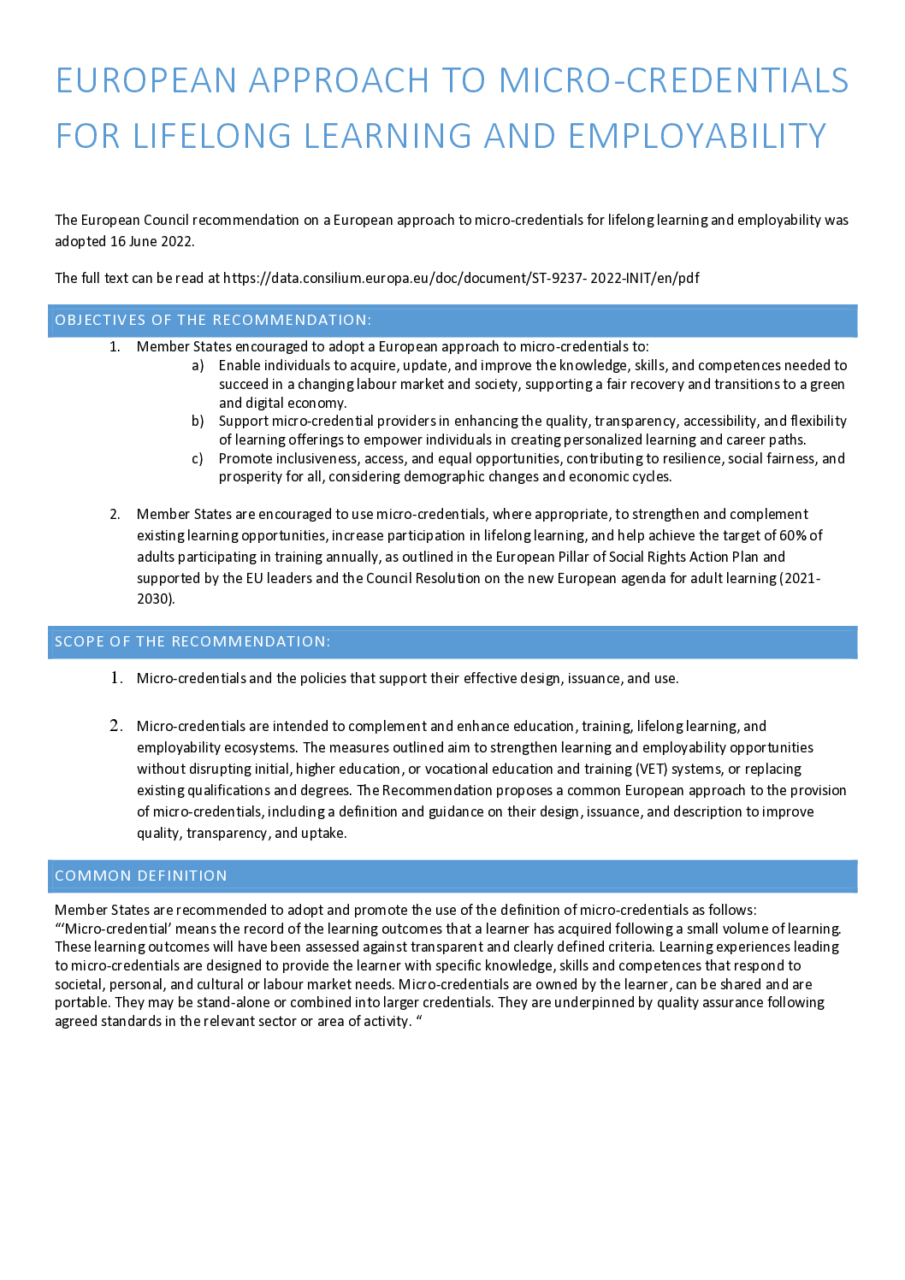
Objectives of the recommendation:
- Member States encouraged to adopt a European approach to micro-credentials to:
- Enable individuals to acquire, update, and improve the knowledge, skills, and competences needed to succeed in a changing labour market and society, supporting a fair recovery and transitions to a green and digital economy.
- Support micro-credential providers in enhancing the quality, transparency, accessibility, and flexibility of learning offerings to empower individuals in creating personalized learning and career paths.
- Promote inclusiveness, access, and equal opportunities, contributing to resilience, social fairness, and prosperity for all, considering demographic changes and economic cycles.
- Member States are encouraged to use micro-credentials, where appropriate, to strengthen and complement existing learning opportunities, increase participation in lifelong learning, and help achieve the target of 60% of adults participating in training annually, as outlined in the European Pillar of Social Rights Action Plan and supported by the EU leaders and the Council Resolution on the new European agenda for adult learning (2021-2030).
Scope of the recommendation:
- Micro-credentials and the policies that support their effective design, issuance, and use.
- Micro-credentials are intended to complement and enhance education, training, lifelong learning, and employability ecosystems. The measures outlined aim to strengthen learning and employability opportunities without disrupting initial, higher education, or vocational education and training (VET) systems, or replacing existing qualifications and degrees. The Recommendation proposes a common European approach to the provision of micro-credentials, including a definition and guidance on their design, issuance, and description to improve quality, transparency, and uptake.
Common Definition
European Standard elements to describe a micro-credential:
- Identification of the learner
- Title of the micro-credential
- Country(ies)/region(s) of the issuer
- Awarding body(ies)
- Date of issuing
- Learning outcomes
- Notional workload needed to achieve the learning outcomes (in ECTS, where applicable)
- Level (and cycle, if applicable) of the learning experience leading to the micro-credential (as per the European Qualifications Framework or Qualifications Frameworks in the European Higher Education Area, where relevant)
- Type of assessment
- Form of participation in the learning activity
- Type of quality assurance used to underpin the micro-credential
European Principles for the design and issuance of micro-credentials:
- Quality
- Transparency
- Relevance
- Valid Assessment
- Learning Pathways
- Recognition
- Portable
- Learner Centred
- Authentic
- Information and Guidance
Policy and European Context:
- Council of the European Union
https://data.consilium.europa.eu/doc/document/ST-9237- 2022-INIT/en/pdf - Microbol Framework
Micro-credentials linked to the Bologna Key Commitments (Microbol) – EQAR
https://www.eqar.eu/about/projects/microbol/ - European Union Higher Education package: a first step on a long journey – European Students’ Union
https://esu-online.org/wp-content/uploads/2022/02/European-Union-Higher-Education-package_-a-first-step-on-a-long-journey.pdf
Preview