Strategy Tool for Microcredential Courses in VET
Before downloading this worksheet, make sure to read the instructions below
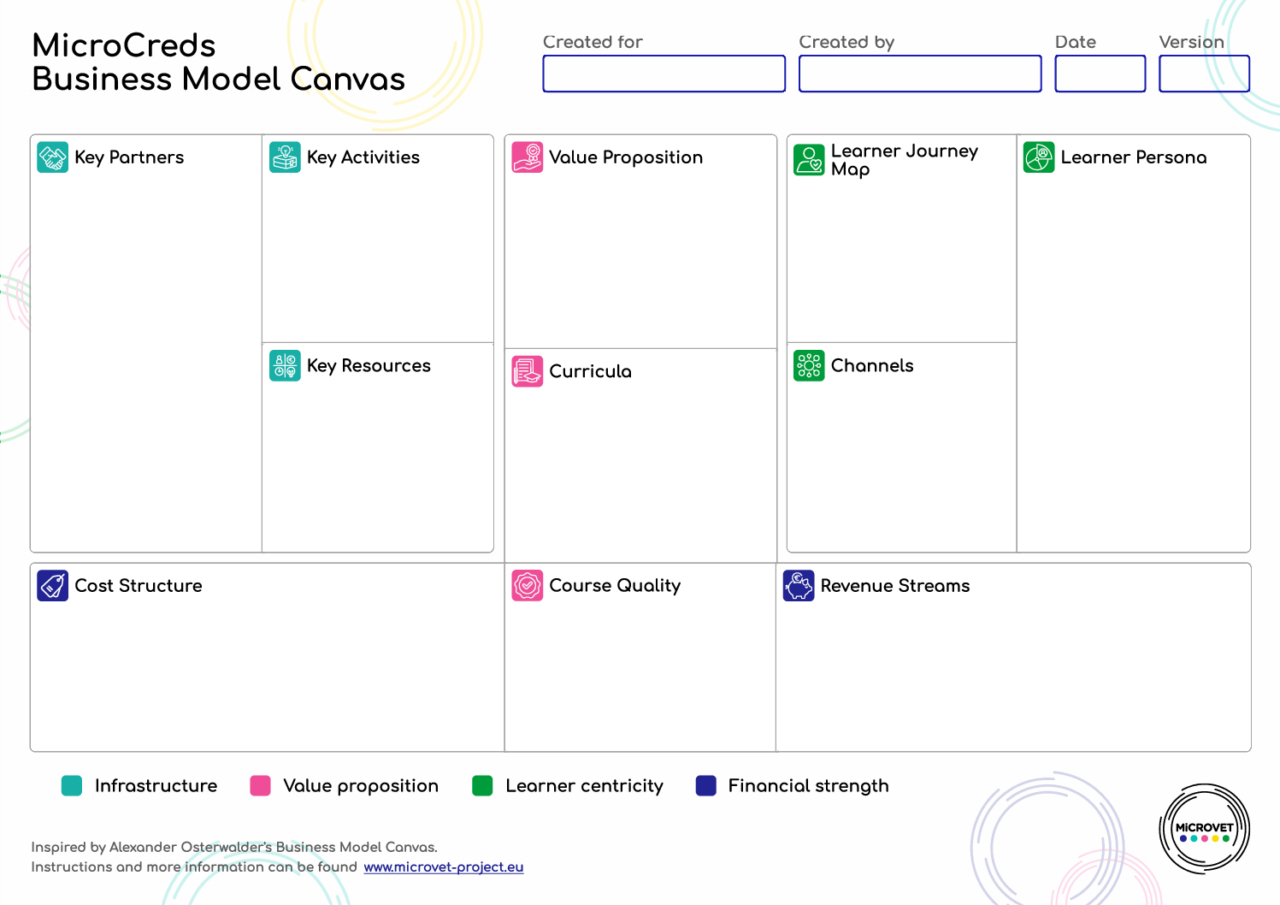
The MicroCreds Business Model Canvas (MBMC) is an adaptation of the Business Model Canvas (BMC), designed to help educators and course developers create learner-centric, labour market-relevant, and financially sustainable microcredential courses. The MBMC maintains the structure of the BMC but shifts its focus to vocational education by emphasising the needs of learners, and creating sustainable, labour market-relevant educational programs.
This model helps structure your course by breaking it down into essential components that ensure a comprehensive and effective programme design. Each section of the canvas represents a key aspect of your course, guiding you through the steps needed to plan, develop, implement and assess your micro credential course. Additional worksheets are provided to help you explore each section in depth.
Usually start from the right – the learner persona. However, if your training provision and delivery is most influenced by training requests from partners or by specific resource requirements, it is also worth starting the mapping from curriculum or resources.
Step-by-Step Guidelines for Applying the MBMC
1. Learner Persona
The very first question you should answer is: “Who will benefit most from this course?”. The learner persona allows you to tailor the course to meet the specific needs, motivations, and challenges of your learners. Complete the learner persona worksheet to document key characteristics, including their goals, challenges, and motivations. Understanding your audience is crucial for designing a course that meets their specific needs.
When creating a learner persona, it is highly recommended to conduct target group interviews or distribute questionnaires. These methods provide valuable insights into learners’ specific needs, preferences, challenges, and motivations, which can be difficult to gather through other means alone. Through these conversations or questionnaires, you gain a more nuanced understanding of learners’ goals, daily constraints, and pain points, allowing you to build a persona that genuinely reflects the target audience
2. Value Proposition
After defining the learners’ persona, you should identify the value proposition. This is the foundation of the course. By defining the value the course provides for learners, you clarify its purpose and set the direction for all other components. Begin by defining what makes your course valuable to learners. Complete the value proposition worksheet, identifying the specific benefits the course offers, how it addresses learner needs, and what makes it stand out. This box should capture the essence of why learners would choose this course.
3. Learner Journey Map
The aim is to map out the journey learners will follow from discovering the course to completing it. Use the learner journey map worksheet to detail each step learners take and the support they need from the provider at each stage. This approach ensures that learners have a seamless experience throughout the course and the course offers a smooth, engaging, and supportive experience, improving both retention and completion rates. Learner journey could include communication points, engagement strategies, and support mechanisms to enhance the learning experience.
4. Channels
The aim is to identify how learners will discover, access, and engage with the course. You need to decide on the course format, whether it will be an e-learning module or a traditional classroom-based training, based on the learner persona defined at the beginning of the design process. Similarly, determine how you will market the course to potential learners, ensuring that your approach aligns with the needs and preferences of the learner persona. These decisions ensure that learners can easily discover the course and access its content in a format that works for them, improving outreach, accessibility, and learner engagement.
5. Value Proposition
The goal is to craft a clear and compelling value proposition for your micro-credential course – one that resonates with your target learners. To achieve this, leverage insights into their specific needs, motivations, and challenges. Highlight the unique combination of skills, knowledge, and benefits your course offers, demonstrating how it helps learners achieve their goals. A strong value proposition ensures your micro-credential stands out and delivers tangible, real-world value to the learner.
6. Curricula
The aim is to develop a structured curriculum that aligns with the course’s value proposition and meets the specific needs of learners. You need to decide clear learning outcomes and outline the essential components of the curriculum, including course content, teaching methods, and assessment strategies. Ensure that the curriculum is learner-centered, incorporating various instructional approaches to accommodate different learning styles. By creating a comprehensive and relevant curriculum, you enhance the overall learning experience, ensuring that learners gain the necessary skills and knowledge to succeed in their vocational fields.
7. Course Quality
The aim is to ensure that the quality of the micro credential course aligns with the overall value proposition and enhances the learner experience. Quality assessment is a critical component that influences various aspects of course delivery, including resources, costs, and learner outcomes. You need to evaluate quality indicators and methods for data collection and analysis. By focusing on elements such as curriculum, instructor qualifications, training facilities, and course organisation, you can establish a robust framework for maintaining high standards.
8. Key Activities
Key activities ensure that the course is developed, delivered, and maintained effectively, establishing a smooth learning experience from start to finish. The aim is to outline the essential tasks needed to develop and deliver the course. List the essential actions required to create and deliver your course, such as content development, learner support, and assessment. Use the key activities worksheet to outline each step, ensuring a structured and systematic approach to course delivery.
9. Key Resources
Identify the resources needed for each key activity, as having the right resources is critical for building a high-quality course and supporting learners throughout their learning journey. Complete the key resources worksheet to list essential personnel, technology, facilities, and materials. Linking activities with resources will help ensure that all necessary support is available.
10. Key Partners
Identify external partners who will help support and enhance the course. Document your partnerships in the key partners worksheet, detailing how each partner contributes to the course, such as by providing content, technology, or certification support. Partnerships with key players, such as industry bodies or certifying organisations, add credibility to the course and expand its reach.
11. Cost Structure
Understanding the cost structure is critical for ensuring the course is financially viable. The cost structure worksheet will help you itemise both fixed and variable costs, enabling a clear picture of the financial requirements for your course. When identifying and calculating costs associated with developing and delivering the course, it is important to consider what you described in the Key Activities, Key Resources, and Key Partners sections, as these represent your primary cost drivers.
12. Revenue Streams
This section helps you understand the financial potential of the course and ensures that revenue aligns with programme costs. The aim is to define how the course will generate revenue to cover costs and ensure financial sustainability. Use the revenue streams worksheet to identify and categorise sources of income, such as course fees or government funding.
Preview