It will help you answer the following questions:
- What are the main costs involved in running a micro credential programme?
- How can total costs be calculated for the programme?
- What steps should be taken to determine the break-even point and set a profit margin for the programme?
How to use this worksheet:
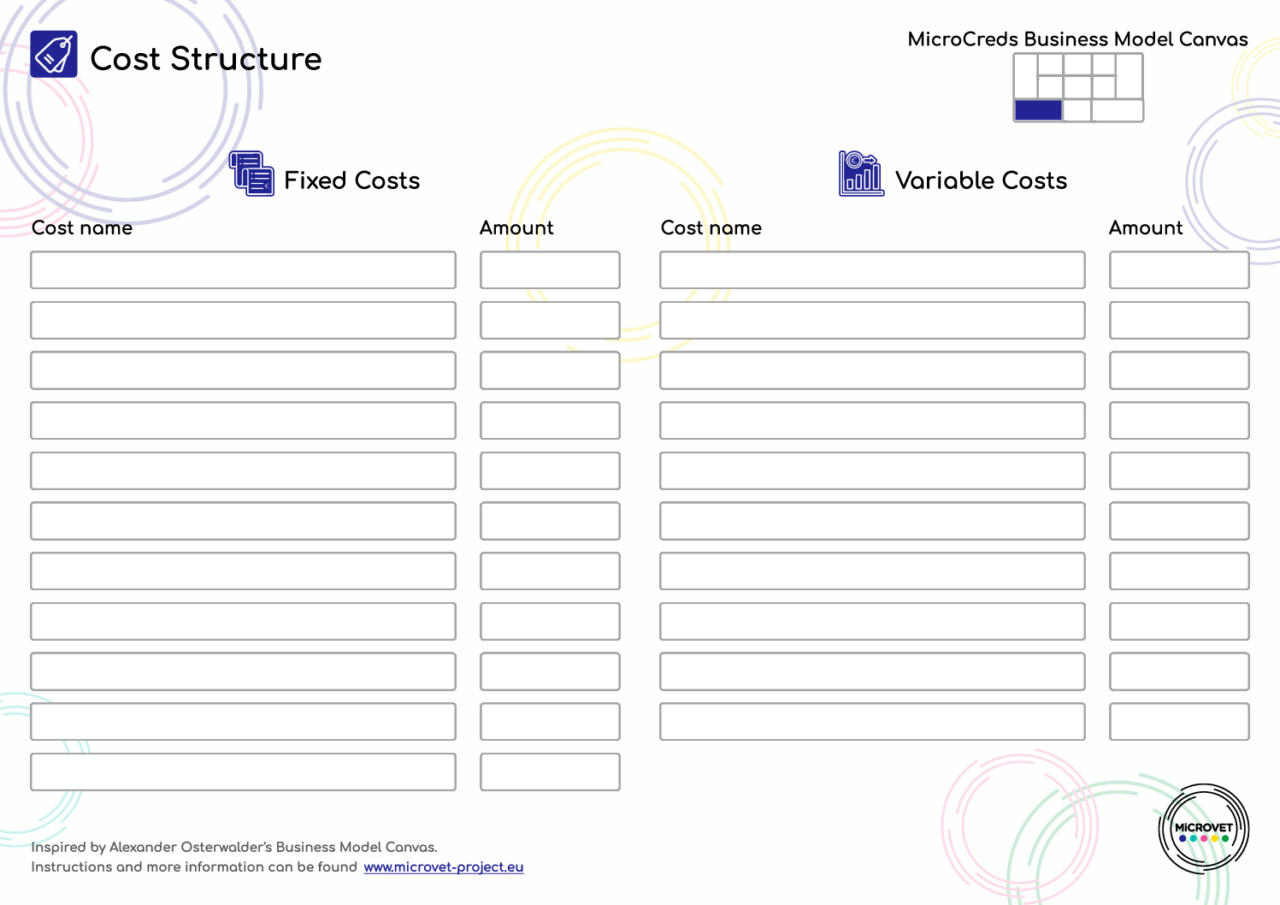
1. Identifying Costs
- Educator Salaries (if on a fixed contract)
- Training Facilities (e.g., room rental, utilities, equipment maintenance)
- Software Licences and Platform Fees (e.g., for a learning management system)
- Course Development Costs (for creating content and materials)
- Marketing and Advertising (if it’s a set campaign cost)
- Administrative Salaries (if unrelated to participant numbers)
- Materials per Participant (e.g., training materials, supplies, equipment or digital resources needed for each learner)
- Hourly or Session-based Educator Fees (if they increase with more participants)
- Certification or Assessment Fees (based on the number of completions)
- Facilities Hire (if additional space is needed for larger groups).
- Technology or Platform Costs: (costs may vary depending on the number of users)
2. Calculating Total Costs
- Fixed Costs: €3,500
- Variable Costs: €1,000 (for 20 participants)
- Total Cost = €3,500 + €1,000 = €4,500
3. Setting Course Fee
- To thoroughly assess each course’s cost-effectiveness and profitability, it is advisable to create a more detailed, supplementary budget for each course.
- You should calculate the break-even point to determine the number of learners required to cover all programme costs (i.e., break even) and the appropriate course fee per participant
- To make the programme sustainable and allow for reinvestment, you’ll likely want to set a profit margin above the break-even point. Let’s say you aim for a 20% profit margin:
- Calculate Target Profit: Multiply the total cost by your desired profit margin.
Example: If total costs are €4,500, then a 20% profit margin would be: €4,500 × 0.20 = €900
- Set Revenue Target: Add your profit goal to the total cost.
Example: €4,500 + €900 = €5,400
- Determine Required Fee per Participant: Divide your revenue target by the expected number of participants to set a fee that covers both costs and profit.
Example: If you expect 20 participants, the fee should be: €5,400 ÷ 20 = €270 per participant
Tips for Effective Use:
- When calculating course development and delivery costs, consider the Key Activities, Key Resources, and Key Partners sections, as they represent your main cost drivers.
- Review Regularly: Costs may change over time, so update your worksheet regularly to keep it accurate.
- Align Costs with Value: Ensure costs contribute to a valuable learning experience.
- Analyse Profitability: Beyond covering costs, aim for a revenue that supports reinvestment in programme quality and growth.